Less friction,
more trust.
Limit management topped the complaints in Voice of the Customer and bogged down manual operations. It wasn't a usability problem. It was strategy disguised as risk policy.
A product with a critical role in revenue, and an experience that undermined both.
Pix limit management wasn't a secondary product. It was tied directly to customers' transaction capacity and, as a result, to revenue. At the same time, it topped the complaints in Voice of the Customer and concentrated a manual operation that kept growing.
Each new Central Bank rule triggered reactive adjustments, with no regard for the impact on experience. The result: a system that grew in complexity without growing in clarity. In the back office, most requests depended on manual review. The review team wasn't growing at the same pace as the requests.
We were treating as risk policy what was actually a system limitation.
Technical limitations of the system were perceived by customers as deliberate risk decisions. No visibility into the rules, no explanation for denials, and a competitive benchmark showing room to improve the experience.
Strategic diagnosis
Friction in limit management was a risk of churn, loss of primary-bank status and competitive vulnerability. Not just a usability problem.
Not approving more requests. Reducing friction, increasing trust, scaling safely.
- Where does the competitive benchmark show room to improve the experience?
- Where do we create unnecessary friction, not because of real risk, but because of operational inefficiency?
- What is real risk, and what is a system bottleneck being perceived as risk by the customer?
- How do we scale this without depending on linear growth in analysts?
Leading discovery: structuring the problem systemically.
I took scattered data (operational, regulatory, experience) and gave it strategic direction. I worked directly with risk and fraud, compliance, back-office operations and engineering, plus a close reading of the Central Bank's regulatory framework for Pix limits.
Four layers cross-referenced to reveal a pattern.
I used an Atomic UX Research approach, organizing experiments, facts, insights and opportunities in a traceable way, instead of leaving each finding on its own.
Operational data
Request volume, SLA by request type, approval rate by channel: the quantifiable bottlenecks before any qualitative hypothesis.
Voice of the customer
Open-ended NPS analysis. A clear pattern: not "slow process", but "I didn't understand why". In validation, satisfaction went up and tickets went down.
Direct observation of the back office
I followed the analysts' work: the systems open side by side and the points where automation failed.
Competitive benchmark and regulatory reading
Analysis of direct competitors' limit policies, and where there was real room for flexibility that wasn't being used.
Synthesis and roadmap structuring
I organized the opportunities into three fronts, prioritized by customer impact, technical feasibility and regulatory risk.

Three structural fronts, instead of one-off improvements.
Discovery became a prioritized roadmap with three fronts, presented to the C-level: transparency for the customer, operational efficiency and automation.
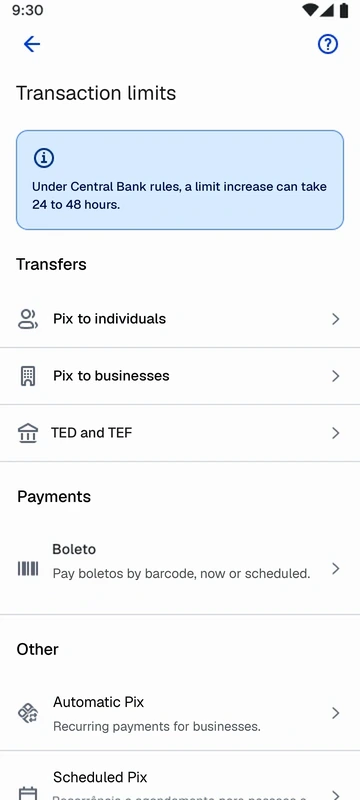
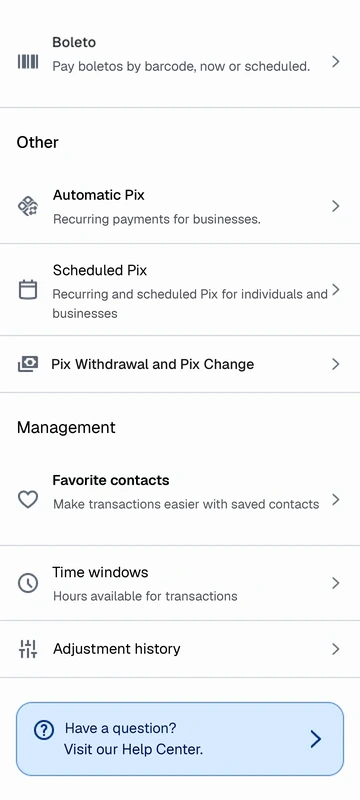

The Central Bank's 24 to 48-hour deadline shows at the top, before any request.
Transfers, payments, other and management. Favorite contacts, time windows and adjustment history live in the same place as the limits.
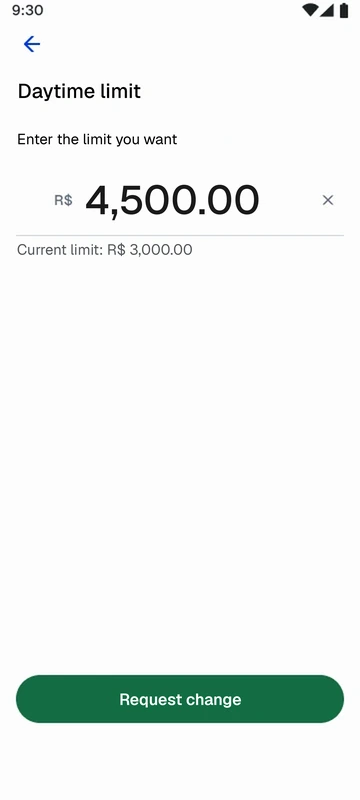
A single field, with the current limit right below as a reference.
If approved, the new limit becomes available within 24 to 48 hours. The same rule from the top of the hub, repeated at the moment it matters.
From cost center to strategic lever.
Discovery consolidated a prioritized roadmap and gave executive visibility to bottlenecks that were treated as "normal operational problems". Limit management was repositioned: from cost center to retention lever.
And CSAT stayed around 75% even with twice the request volume.
What this project teaches about discovery in complex financial products.
- Not all friction is UX. Part of it is product architecture: the "opaque" limit wasn't an interface problem, it was a consequence of how the rules were modeled in the system
- Observing the back office is as important as listening to the customer: every analyst workaround was an uncaptured product opportunity
- Telling real risk apart from system limitation completely changes the priorities
- Discovery without an executive synthesis changes no priorities. Research has to become business language to have real impact
- User autonomy and security aren't opposites. They're good design