Never writes
without asking.
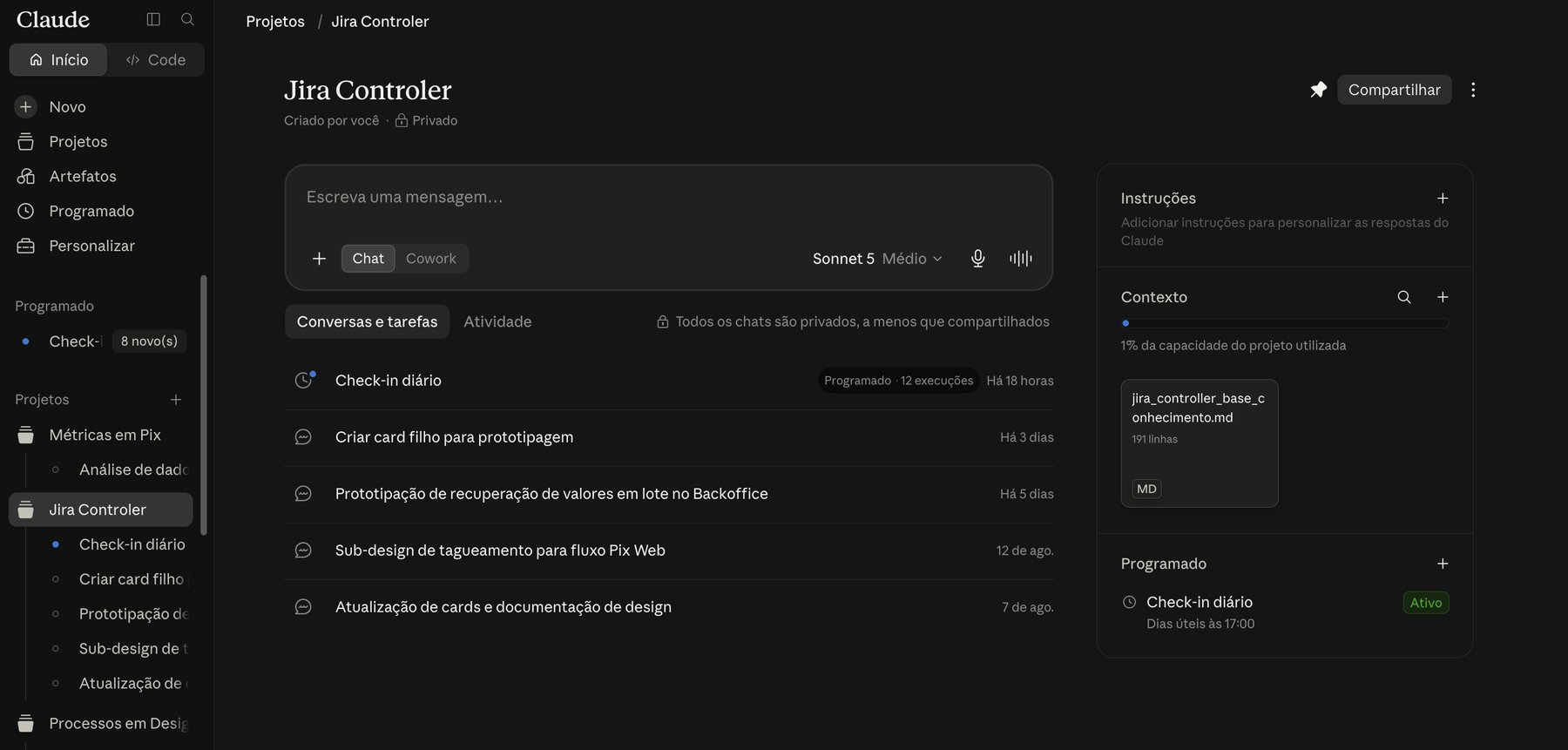
Jira adoption got more structured in design and brought a new problem: keeping cards up to date day by day, at the exact moment of each change. I built a Controller (prompt + scheduled automation) that creates and updates cards from natural language, and never writes to Jira without my confirmation.
The Controller was born for individual use and became the base for two other designers on the team to build their own. Adoption is still maturing. See section 07.
Jira adoption got more structured in design, and brought a new problem.
Keeping cards up to date day by day, at the exact moment of each change, became constant friction. Each squad logged issues however it could, with no standard for required fields, especially Design Type, the classification behind any metric later pulled about what the design team is actually doing.
Stale cards with no updates, mostly missing the issue type.
Without that classification, research, mapping, ideation, usability testing and metrics all blurred together on an uncategorized board. There was no way to answer a simple question with reliable data: where is the design team spending its effort?
Build an automation that creates and updates cards from natural language, with a consistent standard.
The goal wasn't just to stop forgetting to update. It was to take away the designer's need to memorize Jira rules (right field, right type, right link) just to keep their own board current.
I built it for my own use first. It became the base for two other designers to build theirs.
I built the Controller to solve my own problem: my two Jira projects, my field quirks, my way of describing tasks. It wasn't born as a tool designed for the team from day one. Only after it ran for real, with real friction tested in my own use, did two Product Designers on the team take the pattern as a starting point and build their own prompts and controllers on top of it.
It didn't stop at "built it and used it". When adoption started showing up on the whole team's governance board (which covers more than 15 squads across different business areas), I kept tracking the numbers and raising the topic with leadership whenever I saw a gap. A real example: I found completed items with no Design Type and took it to leadership, asking for support to have the fixes followed up with their teams. The automation solves the effort of creating and updating, but it doesn't replace the discipline of classifying correctly.
Two prompts, two moments of use: on-demand creation and an automatic daily check-in.
The Controller operates two Jira projects on the same instance, with different field structures. Before any action, the Controller looks up the issue to confirm which project it belongs to. It never assumes.
There are two issue types in the flow: Design, for macro stages of the process (research, mapping, ideation, testing), and sub-design, a subtask to break a Design card into smaller tasks. Both have a Design Type field, but with different options: Design covers the process stage (Research, Mapping, Ideation, Usability Testing, Metrics), and sub-design covers more visual deliverables (Prototype, Component, Content, Tagging). The agreed rule: if the task doesn't clearly fit an option, the Controller asks before choosing. It never decides on its own.
Every Design card follows a fixed description structure (what will be done, goal, task list) to keep tone and level of detail consistent across the designers using the pattern, not just across my own cards.
- The link to the epic can take two forms: related (
Relates, the most common default) or as a direct child of the epic. The Controller always confirms which one the user wants, instead of assuming the default - To find the assignee, the Controller searches by name. And it learned, in real use, that searching the full name sometimes fails while searching just the first name works better. When it doesn't find a match, it lists similar options and asks, instead of risking assigning the card to the wrong person
- The daily check-in is the second prompt, scheduled to run at 5 p.m. on weekdays. It asks what happened that day, I answer in natural language, and it returns the cards and the update text for me to approve before anything is written to Jira. Nothing is created or edited without my explicit confirmation in the conversation
A Controller that creates, updates and never writes without asking.
The practical result is two routines: creating a card from a loose task description (with an active question when Design Type or assignee is missing), and continuous updates through the daily check-in, always with a preview before any real change in Jira.
One reference card was recorded as the model for tone and structure going forward: an objective description, the goal separate from the description, a clear task list, the epic link documented. That pattern is what spread when two Product Designers on the team built their own controllers.
Real adoption, but not uniform. And it's being handled with active governance, not hidden.
The design team's governance board (which covers more than 15 squads across different business areas) shows 17 designers mapped, with about 65% already classifying correctly, including my own row, marked as a heavy user and "Incomplete". Being the one who built the tool didn't make me immune to the same data discipline problem it exists to solve.
Usage adoption × data quality
There are still completed items without a classification. I took that gap to leadership and asked for support to have the fixes followed up with their teams. Usage adoption (creating and updating cards through the automation) is further along than the quality of the classified data. They're two different metrics, and treating them as the same thing would be misleading.
What this project teaches about automating a process without outsourcing the discipline.
- Automation solves effort, it doesn't replace discipline. Creating and updating cards got easier, but classifying correctly still takes attention from whoever fills it in, and the "Incomplete" rate (mine included) proves it
- A tool born from solving its maker's own problem spreads faster than a tool designed for the team from day one. Two Product Designers on the team didn't adopt an official process. They picked up a solution that had already proven its value in real use
- Confirming before writing is what sustains trust in an automation that touches several people's data. The Controller never creates or edits without a clear intent stated in the conversation. It isn't just a technical rule, it's the reason it can be trusted with the whole team's board
- Being a heavy user doesn't mean perfect data, and admitting it publicly helps more than it hurts. Bringing my own "Incomplete" into governance, instead of hiding it, is consistent with asking others to fix theirs
- A personal tool that becomes team practice needs someone driving its upkeep after the initial shine wears off. The message to leadership about the classification gap is the part of the work that continues after the Controller is already built and running